
Freedom to Choose AI Providers, Models, and Profiles
AI selection should be governed, not accidental
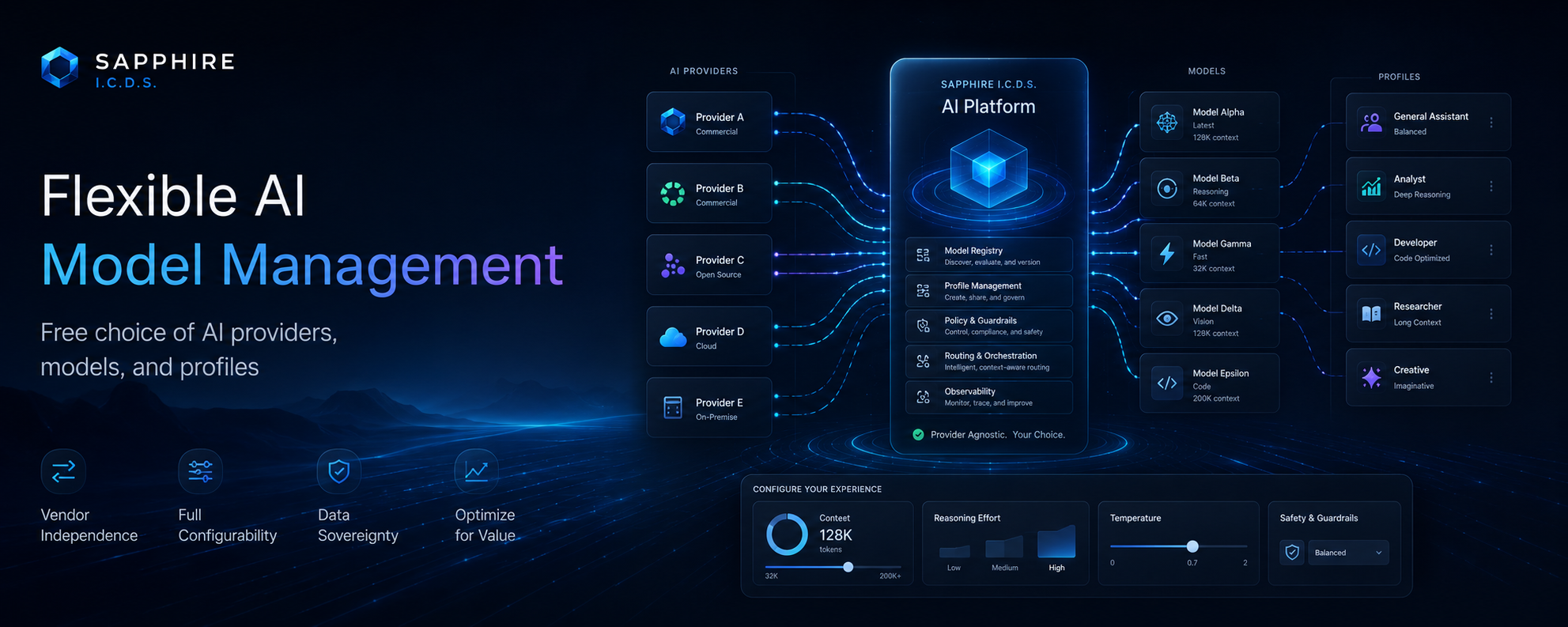
For a business, choosing AI rarely comes down to finding one best model. Legal teams assess data-processing terms, finance directors examine cost, technical teams look at response quality, latency, and reliability, while process owners need measurable outcomes. One model may be better at writing, another at analysing long documents, and a third at handling routine operations quickly. Sapphire I.C.D.S. therefore does not bind the entire AI environment to a single provider-and-model combination. The platform separates configuration into three levels: provider, model, and profile.
A provider is the channel to an AI service
The provider handles communication with a particular external AI platform and translates its specific behaviour into the common internal contract of Sapphire I.C.D.S. The current architecture includes adapters for supported vendors, including OpenAI and Mistral. The actual set depends on the release, the organisation's policy, and the composition of a particular deployment. An administrator can maintain several provider records, control their availability, and keep disabled options out of the user catalogue.
This is an important boundary: freedom of choice does not mean that any HTTP-compatible service can be connected to production without review. A vendor needs a supported adapter, correct configuration, and organisational approval. This approach reduces the risk that an experimental integration quietly becomes part of a critical process.
A model describes real technical capabilities
One provider may offer several models with different context limits, output capacities, and intended uses. Sapphire I.C.D.S. stores the model separately from both the vendor and the profile. The organisation can therefore state clearly which models are available, which are temporarily disabled, and which constraints the user interface and AI agent must observe. Models intended for ordinary text do not have to be mixed with models for another capability: the catalogue can account for purpose and avoid offering an unsuitable option in standard chat.
For management, this creates a transparent capability map. Instead of a vague setting labelled use AI, the organisation receives a list of approved models and can see where a large context is required, where a more economical option is sufficient, and where a special output format is needed. When a provider updates its product line, a new model can be added and tested under control without changing every business module.
A profile turns a model into an operating policy
A profile connects the selected model to the settings of a particular use case. It can define the system instruction, reasoning level, allowed variability, maximum answer size, result format, streaming behaviour, active context budget, and a reserve for compaction. For long-running agent tasks, the profile may also include operational limits. A profile can be enabled, disabled, or selected as the default.
Profiles give the same model different roles without duplicating the integration. A content-editor profile may require a structured and complete text, an operator profile may require a concise answer grounded in approved tools, and an analytical profile may use a larger context and a stricter instruction. Configuration becomes reproducible: employees no longer need to reconstruct request parameters manually for every task.
How this affects cost and quality
Separating the three levels supports a portfolio approach. Frequent and predictable operations can use an economical profile, complex tasks can use a more capable one, and new models can first be tested in a limited setting. Switching does not require rewriting the schemas of platform tools: the common AI environment normalises their use, while each provider adapter retains the vendor-specific request format.
- Cost is controlled through model choice, output limits, and the context budget.
- Quality is stabilised through a system instruction and profile rather than each user's ad hoc settings.
- Risk is reduced through central enablement of providers and models.
- Migration is simpler because business tools are not designed around one AI vendor's format.
What remains under administrator control
Choosing a model in the interface does not override corporate policy. A user sees only active options, while access to AI and its tools is determined by the server from a validated account and group rights. A profile cannot open a new tool by itself, widen permissions, or replace the user's identity. Provider credentials are also not part of the user's selection.
A practical adoption process is straightforward: the organisation defines acceptable vendors, registers the required models, creates several clearly named profiles, selects a default, and validates every scenario against its own data. The technical team then measures quality, response time, and consumption, while the process owner approves the working combination.
Independence without false promises
The architecture reduces dependence on a single provider, but it does not make different models identical. A provider change still requires renewed checks of instructions, tool-calling quality, context constraints, and response formats. The platform supplies one governed layer for that work; it does not promise automatic equivalence between all AI services.
For a business owner, the result is preserved negotiating and technology freedom. For a technical director, it is the ability to govern the catalogue centrally, conduct staged tests, and change a model without rebuilding business logic. The provider remains a replaceable technology component, the model a measurable resource, and the profile an approved method of applying it.