
Mirage templating, multi-layout, and multi-skin presentation
Mirage templating, multi-layout, and multi-skin presentation
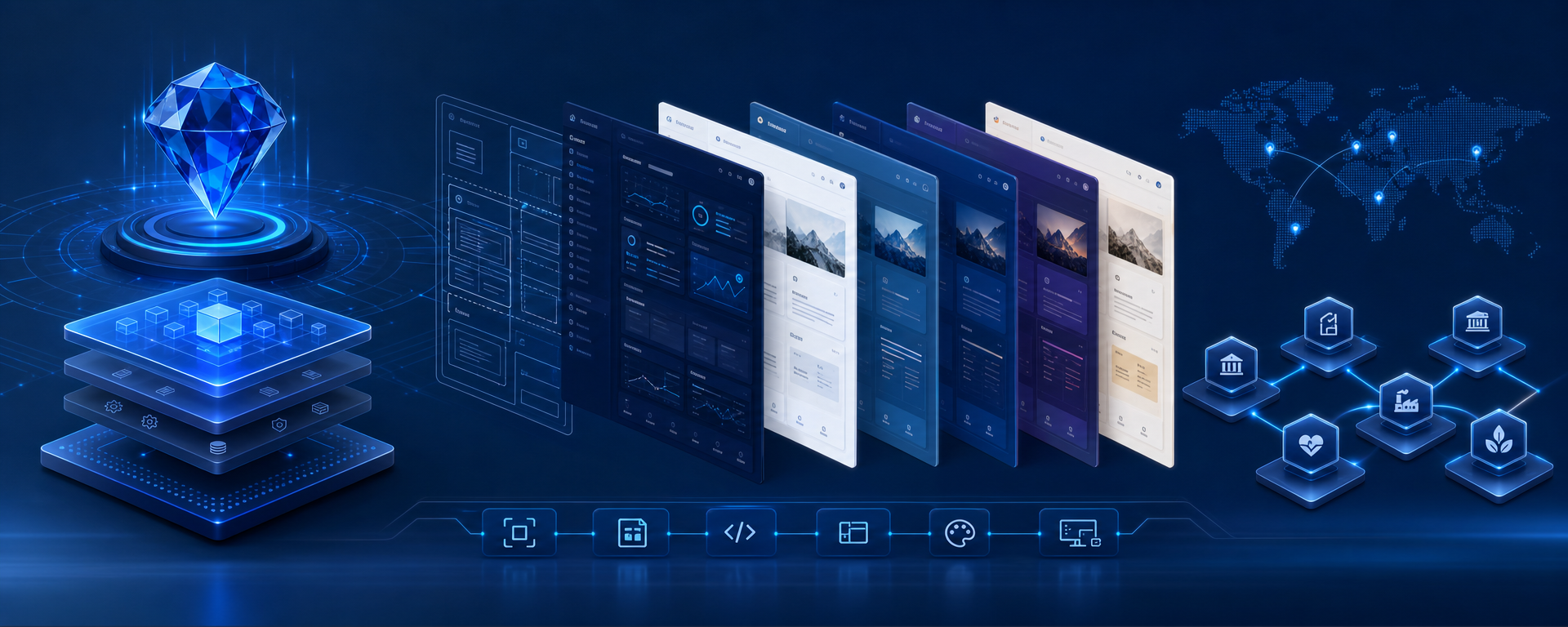
Sapphire I.C.D.S. is designed to give businesses more control over how their platform looks, behaves, and adapts across different domains and presentation scenarios.
This is achieved through a combination of Mirage templating, data-driven rendering, multi-layout logic, and multi-skin presentation control inside one self-hosted system.
Rather than forcing every project into one rigid frontend structure, Sapphire I.C.D.S. is built to support different public-facing views over the same controlled business core.
Mirage as the presentation layer
At the center of Sapphire I.C.D.S. presentation flexibility is the Mirage templating engine.
Mirage provides the author-facing template layer used to render pages, structured data, interface fragments, and dynamic outputs. It builds on top of the underlying macro system while adding project-facing helpers for working with tables, named context data, localized labels, UI zones, and generated form controls.
This makes Mirage more than a simple text template engine. It becomes a practical presentation layer for real business projects where content, structured data, localization, and dynamic rendering need to work together inside one coherent system.
Template logic built for real platform work
Mirage is designed for practical rendering tasks rather than decorative templating alone.
Templates can work with structured request-scoped data, named tables, conditional logic, loops, trusted raw HTML output, and localized interface fragments. This allows the platform to assemble output in a way that remains flexible without becoming chaotic.
For business projects, this matters because presentation often depends on more than static markup. Real platforms need conditional sections, structured records, generated controls, localized labels, reusable zones, and dynamic output based on the actual data context of the request.
Mirage is built to support exactly that kind of work.
Presentation that follows business structure
A major strength of Sapphire I.C.D.S. is that presentation is not isolated from platform logic.
Mirage works alongside the platform’s data and workflow layers, which means templates can render not only simple pages, but also structured entities, business-specific layouts, dynamic sections, form-driven views, localized outputs, and module-specific frontend behavior.
This allows the visible part of the platform to remain closely connected to how the system actually operates behind the scenes.
Instead of treating presentation as a disconnected theme layer, Sapphire I.C.D.S. treats it as part of a controlled business system.
Multi-layout for domain-based presentation logic
Sapphire I.C.D.S. also supports multi-layout scenarios designed for projects that need different public-facing behavior depending on the domain being used.
In practical deployments, hosting aliases can point to the same system directory, while the platform resolves the active domain and applies a different layout configuration through the administrative backend. This allows one installation to serve different module sets, presentation structures, skins, and frontend behavior depending on which domain is being accessed.
That creates a strong foundation for portal-style deployments, multiple branded fronts over one system, domain-specific presentation logic, and controlled variation without duplicating the whole installation.
This is especially valuable for businesses that want centralized management while still presenting different public experiences across domains or project variants.
Multi-domain without fragmentation
Many systems solve multi-domain needs by multiplying installations. That creates duplication, maintenance overhead, and unnecessary operational complexity.
Sapphire I.C.D.S. takes a more disciplined approach.
Its multi-layout model allows one business core to support multiple domain-facing representations through configuration rather than fragmentation. This means businesses can manage shared logic and shared data centrally, while still exposing different presentation models where needed.
The result is a more scalable and more maintainable approach to portal-style or multi-front deployments.
Multi-skin flexibility
In addition to layout-level control, Sapphire I.C.D.S. supports multi-skin presentation.
When more than one skin is available, the platform can switch between them, allowing the same system and the same structural foundation to be visually presented in different ways. This creates more freedom at the presentation layer without requiring the business to rebuild its operational core.
This is useful for projects that need visual variation, brand-oriented front differences, presentation experiments, or different stylistic modes over the same functional platform.
Multi-skin support adds another layer of adaptability while keeping the system itself coherent.
A stronger model for customizable platforms
The combination of Mirage, multi-layout logic, multi-domain routing, and multi-skin presentation makes Sapphire I.C.D.S. far more adaptable than products limited to one static theme model.
This matters because serious business platforms rarely remain visually or structurally identical forever. They grow, branch, adapt, and serve different audiences. A platform that cannot support that evolution becomes limiting.
Sapphire I.C.D.S. is built to support that evolution in a controlled way.
Controlled flexibility instead of frontend chaos
What makes this model valuable is not just that it offers flexibility, but that the flexibility is structured.
Mirage does not exist to encourage uncontrolled template sprawl. Multi-layout does not exist to create disorder across domains. Multi-skin does not exist to turn the platform into a visual patchwork.
All of these capabilities are meant to work inside one managed system where presentation can change without breaking the platform’s architectural coherence.
That is the real strength of the Sapphire I.C.D.S. approach.
Not just customizable output, but controlled customizable output.
Presentation as part of a serious platform
In Sapphire I.C.D.S., presentation is treated as a first-class platform capability.
Mirage provides a strong rendering layer. Multi-layout allows domain-based variation. Multi-domain deployment enables multiple fronts over one system. Multi-skin support adds visual flexibility without operational duplication.
Together, these capabilities make Sapphire I.C.D.S. suitable not only for standard websites, but for more demanding business platforms where presentation must remain adaptable, scalable, and connected to the real structure of the system.
That is what turns presentation from a cosmetic concern into part of the platform’s real value.