
Partnership with Sapphire Project Sp. z o.o.
Sapphire Project Sp. z o.o. is open to cooperation with web studios, design firms, frontend developers, integrators, resellers and other professional teams that need not just another CMS, but a living, expandable system on top of which they can quickly launch client projects and build their own solutions.

We view partnership as a practical working model: the partner brings the client, project or direction, while we provide the technological foundation, advisory support and, when needed, participation in the launch and adaptation of the solution to the specific task.
What the partner gets
Partners get access to a system that is designed from the start not as a template website, but as a foundation for more complex digital products. The platform already includes template rendering, modular interface assembly, SQL templates, multilingual operation and agentic AI tools. The platform is aimed at further customization and growth rather than a rigid, hard-coded closed template.
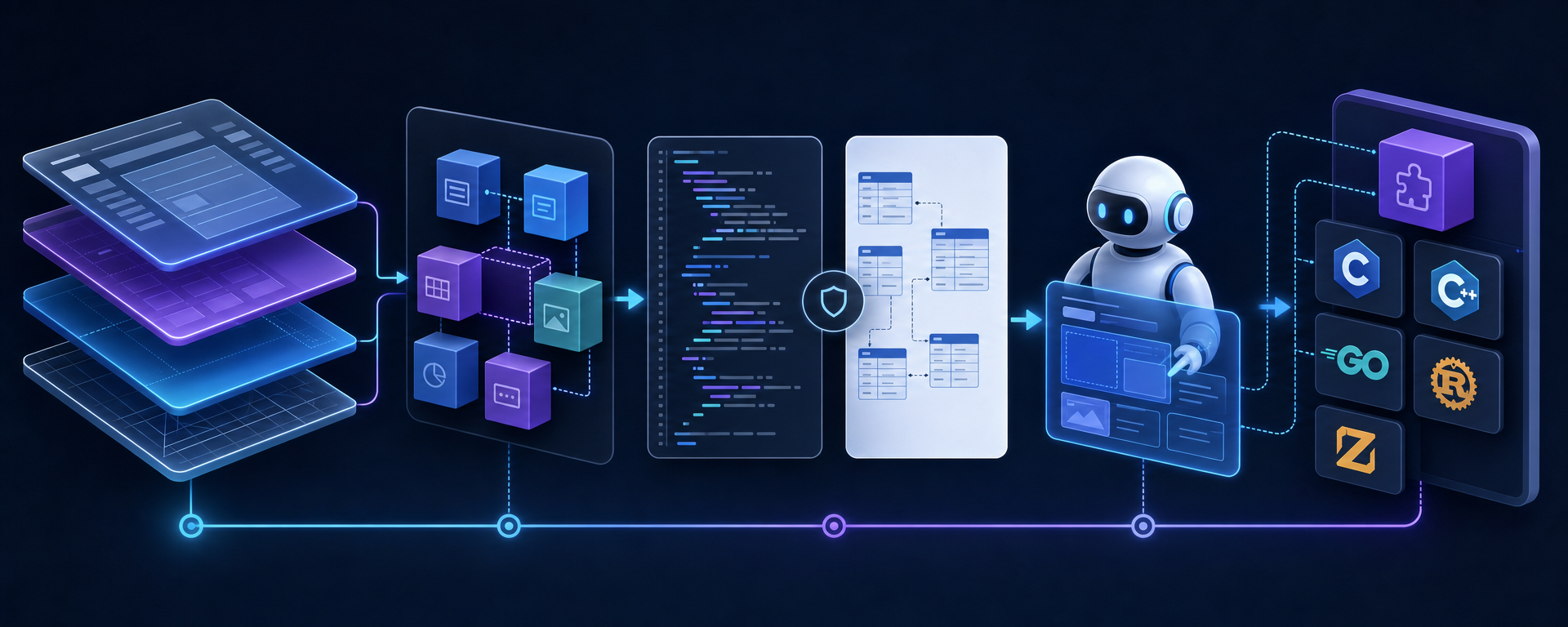
One of the key advantages of the system is that templates and SQL logic are separated from the main codebase. This makes the design and adaptation of client solutions much easier: styling, data presentation and application scenarios can be changed faster, without having to touch the core server side every time.
For the template layer, we use our own macro engine with a Jinja2-like model, which makes working with templates more understandable and convenient for layout specialists. It is also important that no C++ knowledge is required to work with the templates and the visual side of the system. This allows designers, layout specialists and frontend professionals to join the project faster and work on their part of the task without an unnecessary entry barrier.
An additional advantage of this model is its flexibility and the separation of the template layer from the main program code. This already allows external AI tools such as Codex or Claude to be used, even before the built-in AI layout assistant is released, to speed up the preparation of client mockups and the assembly of a basic page framework. In practice, this means that a partner can give the AI a starting reference, a desired structure or a default mockup and get a clean draft for a specific project much faster. Unlike solutions where templates are hard-coded or tightly mixed with the application logic, this approach makes it possible to use AI as a real tool for accelerating layout work and adapting pages for the client without breaking the system architecture or creating unnecessary dependence on low-level server logic.
Why agencies and studios find this interesting
For design and web studios, this means a faster entry into a project without having to build their own server system from scratch. For layout specialists and frontend teams, it provides a manageable template layer that can be adapted to a specific client without heavy coupling to the platform’s low-level logic. For integrators and resellers, it provides a foundation on which client solutions can be assembled faster, with a higher level of control and room for further development.
For partners, it is especially important that the system allows projects to be built not as one-off websites, but as living and extensible working solutions. This makes it possible to offer clients not only the initial launch, but also further development, new modules, localization, AI features and additional workflows.
Future development for partners
- Introduction of an onboard AI layout assistant that should noticeably reduce the time spent preparing and adapting templates, and speed up the overall work on client projects.
- Development of an IPC layer for third-party modules with support for C, C++, Go, Rust and Zig. This will give partners the ability to build their own extensions and specialized modules for their clients faster, without breaking compatibility with platform updates.
At the same time, partners will be able to retain full control over their own modular logic and develop it independently without losing the support of the main system.
Forms of cooperation
- partner sales and reselling;
- white-label and project-based cooperation;
- joint launch of client projects;
- customization for a specific niche or business model;
- consulting and technical support during implementation.
Within the partnership model, the company may provide a discount of up to 30%, as well as training, initial technical assistance and consulting when needed. This helps partners enter the working process faster and offer clients not an abstract idea, but an existing living foundation.
Support and follow-up
We understand that for partners, not only the license or access to the system matters, but also predictable cooperation. That is why, within the partnership model, we are ready to provide not only the technological base, but also help with the initial onboarding, answers to architectural and practical questions, and support in those scenarios where it is genuinely necessary.
Who this is for
- can sell digital services but does not want to build its own platform from scratch;
- works with client websites, portals and administrative systems;
- wants a working technology base for further customization;
- is looking for solutions with a higher level of control than template-based mass CMS platforms;
- sees AI and agentic layers as a practical extension of web systems, not as a decorative feature.
Start the conversation
If you are interested in discussing partnership, white-label, reselling or a joint project launch, contact us through the feedback form or using the contact details listed on the website. We are open to businesslike, pragmatic cooperation and prefer to discuss real use cases rather than abstract promises.